
Tagan Simon
Summary of My Experience
Notebook Sample
June 25, Day 1
Personal Reflection
My day usually revolves around plants and nature.
Entering the property exposed me to new tree species and gave me a chance finally see some tree species I have never seen. The Winged Elm, Virginia Pine, Sourwood, Butternut Hickory and Possum-haw were all interesting and new tree species to me. I documented pictures of the key features to help with remembering them. I was very excited to see the water oaks, sweet gums and pecan trees that I am very familiar with. Much of my time observing was spent looking at the developing pecans or red holly berries as they drastically stand out in the green and brown filled forest. At the creek I noticed duckweed, which was one of my favorite finds.
The creek had an interesting bottom full of rock which was new to me. The bank was interesting many rocks were smooth and elongated. I took in lots of air while there but I decided to head back before any ticks or chiggers caught me. Because I didn’t walk to left to wards the fields, I didn’t explore the plants growing, with little to no shade. Tomorrow I hope I have time to check that out.
June 26, Day 2
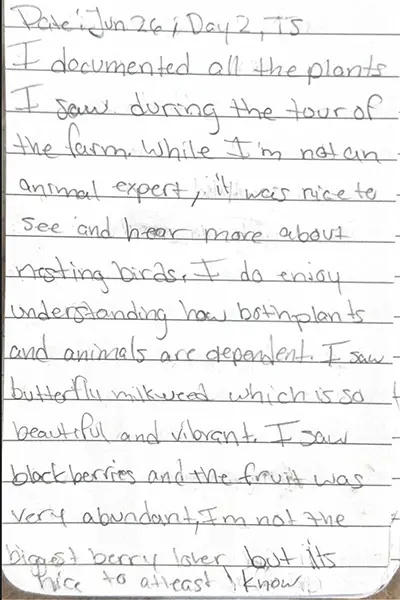
I documented all the plants I saw during the tour of the farm. While I’m not animal expert, it was nice to see and hear more about nesting birds. I do enjoy understanding how both plants and animals are dependent. I saw butterfly milkweed which is so beautiful and vibrant. I saw blackberries and the fruit was very abundant, I’m not the biggest berry lover but is nice to at least know of what is available to forage in the forest. I saw Crepe Myrtles, which have really pretty flowers, even though it is not native to South Carolina. While on the tour I believe I saw wild carrot or Queen Anne’s lace. If we were to depend on the land to survive it’s important to run an identification of the mystery species before committing to eating it.
Plant observed on tour:
water oak- American holly – dog fennel – praire grasses – white oak -sweet gum -turkey oak – johnson grass -milkweed – buckweed – magnolia – wild carrot/ queens anne’s lace – brown eyed-susan – smilax – pecan – crepe myrtle -pokeweed – clover – century plant/blue agave – hydrangea – fleabane – horse nettle – blackberry – tall tallow daisy – thistle – red cedar
We did go to the creek while it rained which was a little cold but seeing the creek with more water from yesterday was amazing. The bank does have more diverse shape and color to the gravel/pebbles on the farthest side. I was able to feel the strange rocks under my boots, and they were very slippery. I briefly had time to go look at plants while working and Water Oak was one of my finds. Black-eyed Susan, a flower I like that is in the daisy family was all over the fields. Tomorrow, I hope to strengthen my tree knowledge. I would care to identify trees like Water Tupelo, Witch Hazel, Black Cherry and Persimmon, all of which are on my list of discovery. I feel great because some plants out here have similarities to my not so distant home.
Tour Notes:
The 1st bridge has been on the map since 1825 -in the 1990s pines were planted on the other side of the property line, it has been thinned in the center to create a prairie. This farm is in the slate belt, this causes high erosion. To protect animal life animal life, they don’t mow in May or June.
On April 05, 2007 he brought the land and discovered a grown up cemetery, the Burch family. Horses have been on this property since the lates 1700s.
The statue is 10 years old, made in 2016, it is a carving of and a bald eagle covering it.
Got the log from a woman in NC. it was a fallen tree that had been there a while.
There is a slave grave yard ok the side of the Burch family. DNA test proved that white Burch family was related to black individuals in other places. Money and land was given to the black descendants, the person who made the stones was a black Birch.
Goldstar family -a family that has lost a family member in the military. The second statue was made in honor of the loss of someone’s wife and daughter burning in the family home. It includes a mother cat teaching a baby how to hunt boars. The tree was knocked down because it reminded him of the loss of his wife and child was constantly.
Noah is one of their horses, he was flown in from Belgium, the other horse is named Arnold and he was born in America but his breed is French.
The next carving represents civil war March 4, 1865.
The 4th one is a tree that feel in Thompsons creek, it grew into its own bark and I think that represents the trees will to grow.
5th carving features dogs, sunflowers, brown-eyed susan, birds, plants and a fox. Quails disperse like fireworks so it was fitting for a log lost during a 4th of July storm. There a 4 different bat types here, they took over a trailer
3 houses were on the hill since the 1860.
Dead trees standing because it supports the ecosystem.
